How Shelf Dividers Improve Stock Rotation and Facing
Published 4 September, 2026
7 Min Read
A shelf can look fully stocked and still be losing you sales. Walk the aisle, glance across the facings, everything seems in order. But pull one product forward and you might find last week’s stock still sitting at the back, mixed in with three other SKUs that have drifted into each other’s space over a busy weekend. The shelf looks fine. The stock behind it isn’t.
This is the gap that shelf dividers are built to close. They’re one of the simplest fixtures in a store, and one of the most overlooked, yet they directly affect two things every retailer cares about: how quickly stock moves through the shelf, and how consistently that shelf looks stocked to a shopper walking past. As part of our complete guide to retail shelf management, this article looks specifically at how dividers earn their place on the shelf.

A shelf divider is a physical separator that keeps one product, or one facing, in its own defined space on the shelf. Nothing more complicated than that, but the effect is significant.
Without a divider, product tends to migrate. Pack a shelf with loose stock and, over a day of shoppers picking items up and restocking, facings blur into one another. Dividers stop that. Each SKU stays where the planogram put it, whether that’s a clip-on divider running front to back or a breakable divider slotted into a T-rail.
Dividers and shelf risers get mixed up often, so it helps to separate them clearly. Risers lift product forward as stock depletes, so the front of the shelf always looks full. Dividers work side to side, keeping neighbouring products apart. Most shelf management setups use both together, but they solve different problems. If you’re weighing up the two, our guide to shelf risers vs. shelf dividers covers the distinction in full.
The commercial case for getting this right is bigger than most people assume. Industry estimates put lost sales from out-of-stocks at somewhere between 4 and 8 percent of annual revenue.1 NielsenIQ’s research found that a large majority of shoppers, faced with their usual product missing from the shelf, will pick a different brand rather than wait or go elsewhere.2 That’s not a lost sale. That’s a lost customer for that product, possibly permanently.
Facing plays into this in a way that’s easy to underestimate. A shelf that’s only 40 percent full but properly faced, everything pulled forward, rows straight, reads as well stocked. A shelf that’s 70 percent full but disordered, with gaps, mixed facings and stock pushed back, reads as low or depleted. Shoppers respond to what they see, not what’s actually in the stockroom. Dividers are one of the fixtures doing the quiet work of keeping that visual read accurate.
Rotation errors are usually a spatial problem before they’re a process problem. If there’s nowhere for new stock to go except wherever there’s a gap, staff will put it wherever there’s a gap, and older stock ends up buried behind or beside it rather than at the front where it should sell first.
A divider fixes this by giving each SKU a fixed lane. New stock has to go in behind what’s already there, because there’s nowhere else for it to sit. That’s first-in-first-out enforced by the shelf itself, not by a rule staff have to remember during a busy shift.
This matters most in categories with a shelf life. Chilled, deli and bakery are the obvious ones, where a missed rotation means write-offs, not just a messy shelf. But it applies just as much to seasonal or promotional stock, where last month’s line needs to clear before this month’s arrives.
Not every category needs the same level of divider discipline, but a few stand out.
High-SKU-count categories such as health and beauty, confectionery and haberdashery are the clearest case. Narrow facings and dozens of near-identical pack shapes mean products merge into each other within hours of restocking without a divider holding the line.
DIY and hardware categories bring a different challenge: irregular pack sizes and shapes that don’t sit neatly next to each other. Dividers here are less about rotation and more about keeping a shelf that would otherwise look chaotic looking organised.
Grocery and deli sit somewhere in between, where rotation errors carry a direct cost in shrink and food waste, not just a presentation issue. Get the divider setup right here and the payback shows up on the shrink line, not just the shelf-audit score.
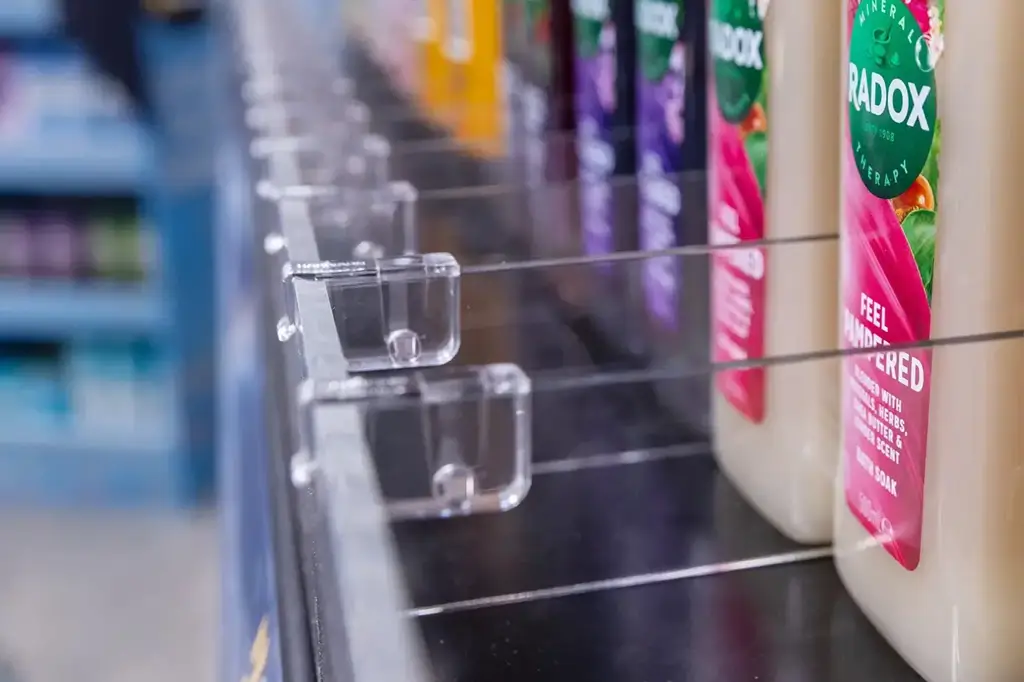
Shelf dividers improve stock rotation by giving each product a fixed space on the shelf, so staff restocking are guided to place new stock behind what’s already there rather than mixing the two. This keeps older stock visible and moving, cuts down on missed sell-by dates, and reduces the time spent untangling facings during a restock.
In short, dividers:
The right divider depends on the shelf, the category and how often the setup needs to flex.
Harrison Retail’s breakable dividers are made from PET and designed to work with a T-rail, either self-adhesive or magnetic. They snap to length, so one part number covers a range of shelf depths rather than needing a different SKU for every size. For large estates with hundreds of stores and varying fixture ages, that’s a real advantage: fewer part numbers to hold, fewer mistakes at store level.
Acrylic dividers with clips are the sturdier option, better suited to categories where the divider itself needs to hold its shape under heavier or bulkier product, and where the transparency of acrylic keeps sightlines to the product clear. Divider clips secure either system firmly to the shelf edge, so nothing shifts when a trolley or a restock knocks the shelf.
Match the material to the category rather than defaulting to one option across the whole estate. PET dividers scale cost-effectively across high-SKU-count categories. Acrylic earns its place where shelf life, weight or visibility make it worth the extra cost.
Shelf dividers are inexpensive relative to almost anything else in a store fit-out, but the effect of getting them wrong compounds across every store in an estate, every week, in shrink, in wasted stock and in shelves that quietly look worse than they are.

Harrison Retail worked with Superdrug to prove the point at scale. Superdrug was running 750,000 shelf dividers across two different sizes, all in PET. We consolidated that down to a single design, moulded with holes in the rear to cut material use, reducing plastic per divider by 8 percent without changing how the divider performed on shelf. Multiply that across three-quarters of a million units and the saving is substantial, in cost and in material.
That kind of consolidation only works with in-house design and manufacturing control, which is where Harrison Retail’s ISO 9001:2015 accreditation matters in practice: consistent specification across every unit, whether the order is for one store or a thousand.
If you’re reviewing shelf dividers or risers for your own estate, view our full range of Shelf Risers & Dividers or get in touch to request the shelf management catalogue. And if you’re still deciding between a riser-led or divider-led setup, our guide to shelf risers vs. shelf dividers breaks down which fixture solves which problem.
1. Industry out-of-stock cost estimates – Frogmi, Agmis retail analytics research.
2. Brand-switching behaviour following an out-of-stock – NielsenIQ.