What Is A Shelf Riser? A Complete Guide For Retailers
Published 18 September, 2026
5 Min Read
Walk down a well-run aisle and you probably will not notice why it works. Every product sits square to the front, upright, easy to reach. Walk down a neglected one and you will notice immediately: cans lean sideways, boxes have slid forward into each other, and the last item on a low-stock line has slipped to the back where nobody’s hand can reach it.
A shelf riser is the fixture that fixes exactly this. It is a small, often overlooked part of a shop’s shelf edge, but it does a lot of work for its size: holding stock upright, keeping a shelf looking full, and in some versions, making it much harder for a product to walk out the door uncounted. This guide covers what a shelf riser actually is, the different types retailers use, and how to pick the right one for a given store.
A shelf riser is a fixture fitted to the front edge of a shelf that lifts, holds, or restricts access to the products behind it. Most are made from clear acrylic and slot into the same T-rail channel used for shelf dividers, so they sit flush with the shelf edge instead of eating into shelf depth.
The category covers more ground than the name suggests. Some risers exist purely to keep stock upright and presentable. Others are built specifically to slow down theft, using gravity, locking, or sliding mechanisms that make it harder to take more than one item at a time. Grocery, health and beauty, DIY, and convenience retailers all use some form of shelf riser, though which one depends on the problem being solved.
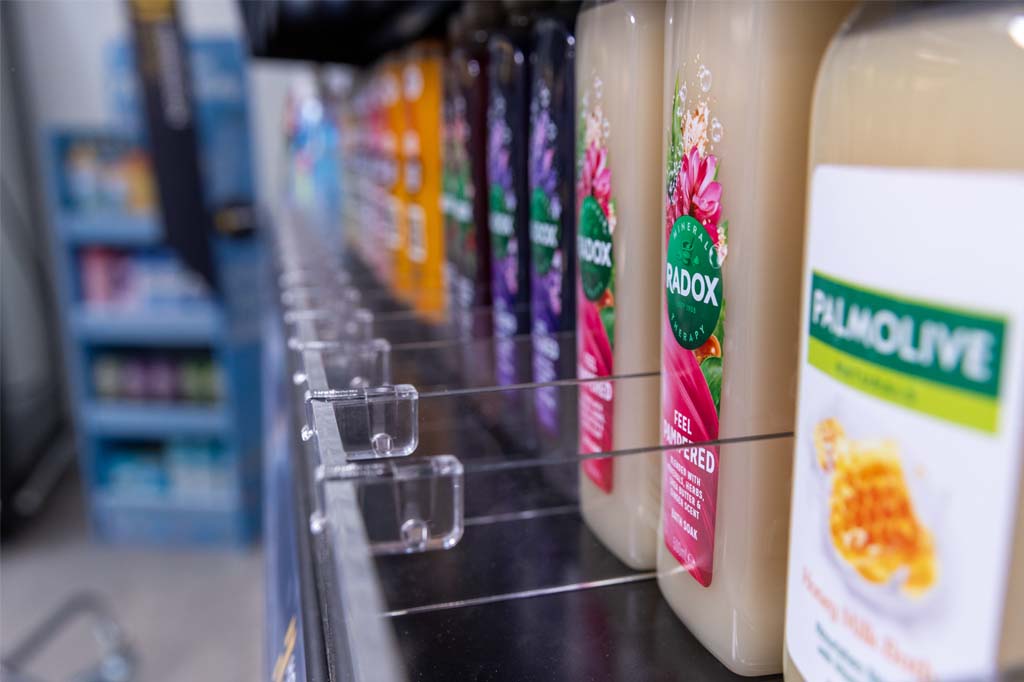
A standard riser clips into a self-adhesive or magnetic T-rail along the shelf edge, the same rail system used for dividers and data strips. Once fitted, it holds products upright and stops them sliding forward as stock sells through, so a half-empty shelf still looks tidy rather than collapsed.
Risers rarely do this job alone. They usually work alongside dividers, which separate products side to side, and pushers, which feed stock toward the front automatically. Each part handles one job, and together they keep a shelf edge organised without much staff intervention.
For the customer, the effect is straightforward: products stay visible and easy to pick up, facings stay full later into a sell cycle, and staff spend less time re-facing shelves by hand.
Not every shelf riser does the same job. It helps to think of them in two groups.
Acrylic shelf risers are the standard type, used purely for presentation. They are transparent, customisable to different shelf widths and heights, and their only job is to stop products slipping forward or off the shelf. If the goal is a neater, fuller-looking shelf, this is usually the right choice.
Anti-theft risers are built for a different problem: reducing shrinkage on higher-risk lines. Harrison Retail’s range includes five variants, each with its own mechanism.
All of these are customisable to different riser heights and shelf widths, so fitting one rarely means replacing existing shelving.
Retailers in categories with a known shrinkage problem, health and beauty, spirits, confectionery, tend to reach for the anti-theft versions first, while general grocery and DIY lines usually only need the acrylic type. A slow-moving, low-value line rarely needs more than an acrylic riser. A high-value line with a shrinkage problem is where the anti-theft versions earn their keep.

The case for fitting shelf risers rests on three things.
Presentation and sales. A shelf that looks organised and fully stocked is more likely to convert a browse into a purchase, and risers are one of the simplest ways to maintain that look as stock depletes through the day.
Loss prevention. Anti-theft risers are built to slow down casual theft without stopping genuine customers from buying, which is a meaningful difference from locking a product away entirely and losing sales because of it.
Staff time. Less time spent facing up shelves by hand leaves more time for tasks that actually need a person, rather than a repetitive job a well-chosen fixture can handle instead.
For a lot of stores, that combination (better presentation and less shrinkage) pays for the fixture within a single stock cycle.
No. A divider separates products side by side to keep individual facings tidy. A riser works on the front of the shelf, lifting or restricting products rather than separating them. Most stores use both together.
Most are acrylic or PET, the same lightweight, clear materials used for shelf dividers. Locking and anti-theft variants add steel brackets or hinges to the mechanism.
Yes. Gravity, dropping, dual, sliding, and locking risers are all designed specifically to make casual theft harder while still allowing normal restocking by staff.

Which riser suits a given store comes down to two questions: is the goal presentation or loss prevention, and what are the exact shelf and product dimensions involved. Material and mechanism follow from there. Acrylic for a straightforward, tidy shelf edge. One of the anti-theft variants where shrinkage is the bigger concern.